

What is this Merchant Silicon thing anyway?
Merchant Silicon (AKA Whitebox) is equipment created independent vendors which can run any Network Operating System (NOS) programmed for it, rather than proprietary hardware and a proprietary NOS.
What isn’t Merchant Silicon?
Any vendor (’traditional vendor’) that is vertically integrated, usually using proprietary hardware and their own proprietary NOS.
What is a NOS?
A NOS is much like a OS on a computer. It takes intent from the user and via policy programs the hardware. NOS’s overall are CLI driven, rather than having a nice graphical UI, so network operators have to learn to love the DOS like CLI, however some NOS’s do come with a graphical UI to obfuscate the CLI commands required to program the hardware.
These UIs (typically firewalls or enterprise devices) bring with them their own complexities such as, creating bloat in the naming conventions, completely hiding some essential commands from the CLI, and/ or being an attack vector for threat actors.
Who provides this Merchant Silicon Hardware?
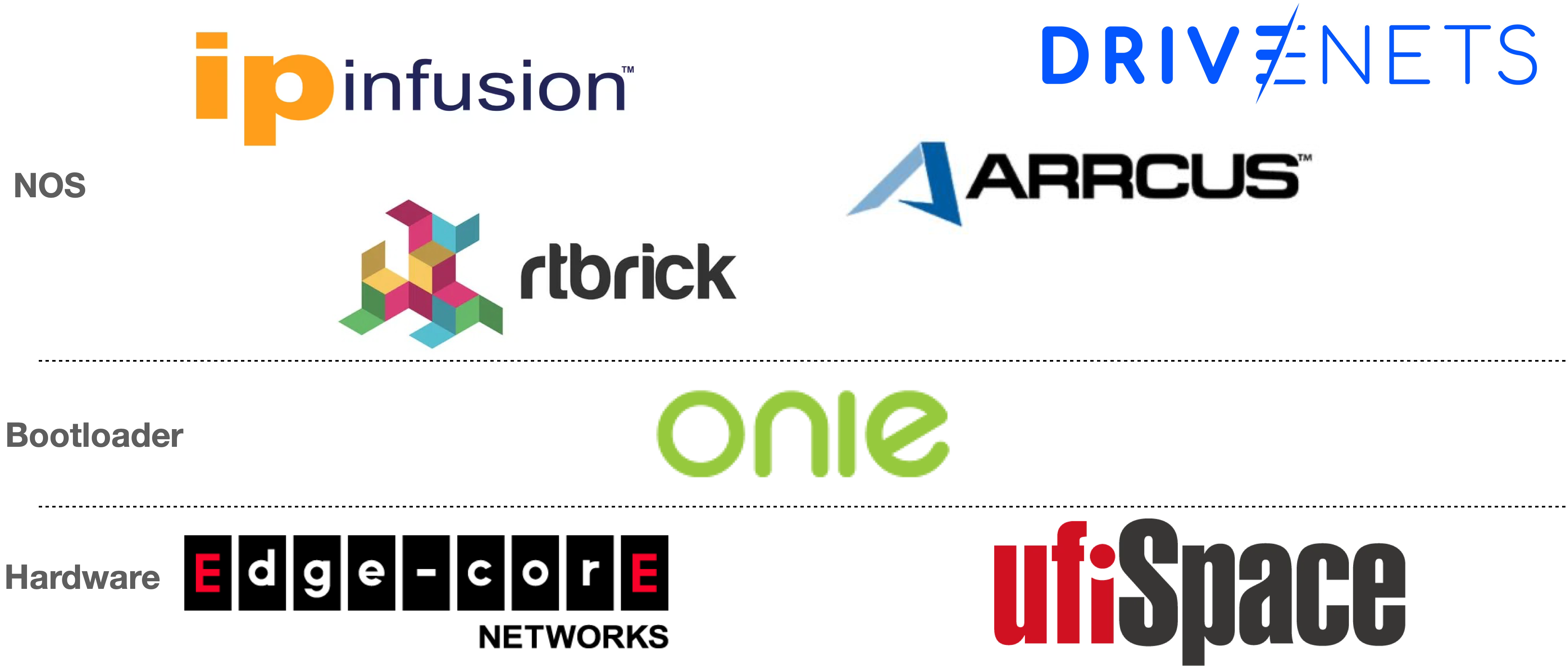
Two of the main vendors of Merchant Silicon are EdgeCore and ufiSpace, however there are several others and some who will build custom hardware as needed.
Merchant Silicon Analogy - PC vs. Mac
A ‘PC’ can be built and configured using any compatible set of hardware and the operating system (OS) can either be a fully supported OS (Windows) or a community one (Linux) or one of your own creation.
A Mac on the other hand is completely proprietary hardware and proprietary NOS.
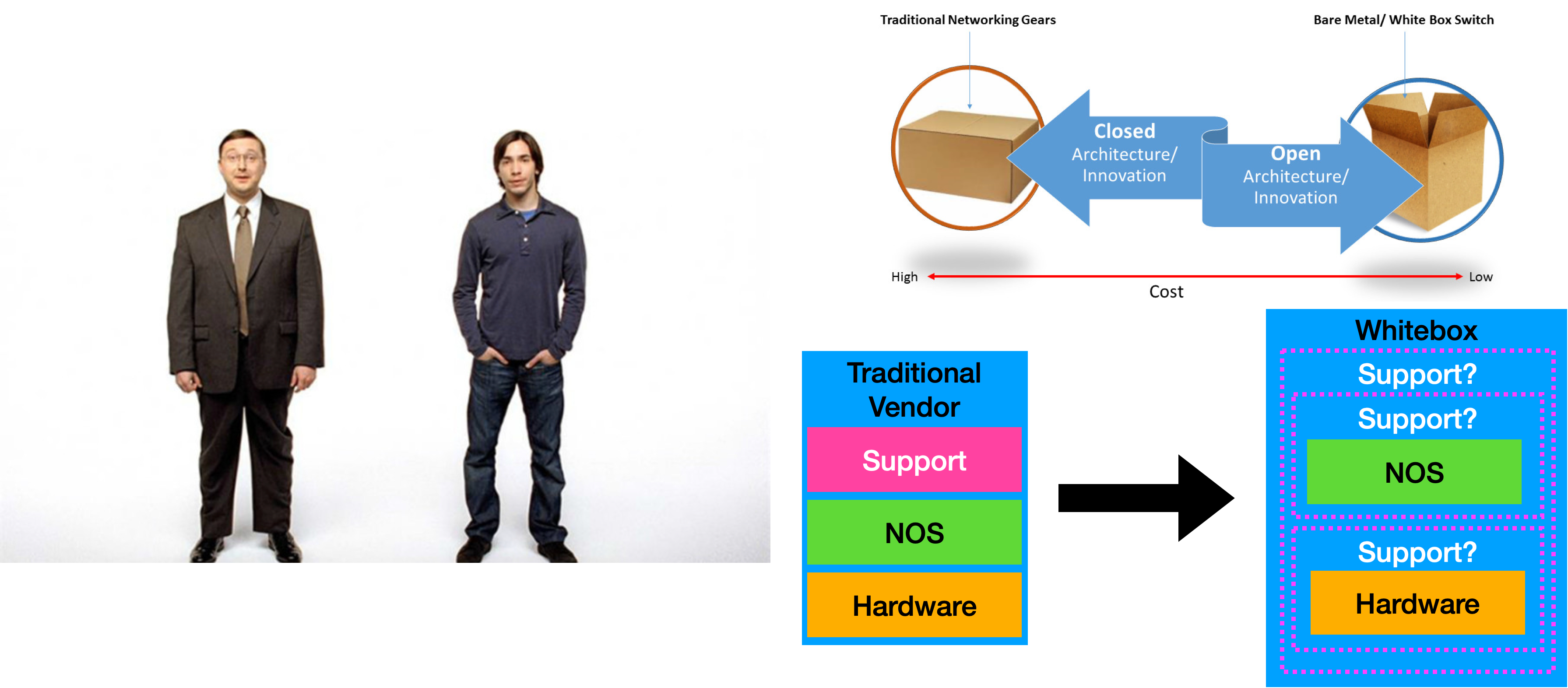
And with that comes some benefits and some challenges.
Potential Benefits
Merchant Silicon hardware bring flexibility to chose hardware and NOS’s on a per use-case basis, rather than the larger tier 1 operators dictating their requirements to vendors and then the rest of the operator community having to live with those outcomes. Overall this is immensely powerful
The economics of using Merchant Silicon are potentially cheaper than traditional vendors.
Running side workloads on the hardware’s compute is the norm, rather than a protracted edge case and/ or not being supported by the vendor.
Potential Drawbacks
Bugs between the hardware and the NOS can be tricky to troubleshoot if there is a limited relationship between the NOS creator and the hardware supplier.
Sparing the hardware is usually down to the operator using it, rather than the vendor or partner supplying it.
The application-specific integrated circuit (ASIC) is usually Broadcom which means a clear set of use case and requirements need to be done and checked solely by the operator, rather than the checks … etc., being supported by the vendor, before settling on hardware and NOS.
Things to Watch out for
Distributed Disaggregated Chassis (DDC)
DDC is a DriveNets Proprietary ‘connector’ and whilst it is supported by the Open Compute Project, it comes at a price when evaluating ufiSpace hardware.
DDC Example
The ufiSpace S9700-23D, looks like it has 23 ports (hence the 23 in the hardware name), however those 23 ports are split up into:
10 x 100/400G QSFP-DD service ports
13 x 400G QSFP-DD fabric ports
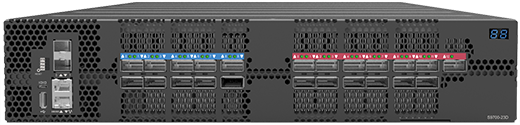
So unless you are running a DDC architecture, buying this specific hardware will leave you with 13 unusable ports.
Where as the S9610-36D has:
36 x 40/100/200/400G QSFP-DD service ports

So be aware the ‘red’ DDC ports.
Convergence Times
Whilst there has been significant improvements in Merchant hardware over the years, and Broadcom’s Jericho line of silicon is always improving, the convergence times of Merchant Silicon solutions is still a little behind traditional vendors.
This is due to to the Mac and PC effect, as traditional vendors can tune their ecosystem, where as the same harmony can’t ben established between independently created hardware and NOSs.
Broadcom Support
Not all NOSs support all of the lower speed Qumran2 Broadcom chipset, example DriveNets only supports the Qumran2c+ chipsets, not the Qumran-UX (120Gbps), Qumran-AX (300Gbps), Qumran2u (360Gbps) and/ or Qumran2a/ Qumran-MX (800Gbps), which can be very handy in small street furniture deployments.
Broadcom StrataDNX™ vs. StrataXGS®
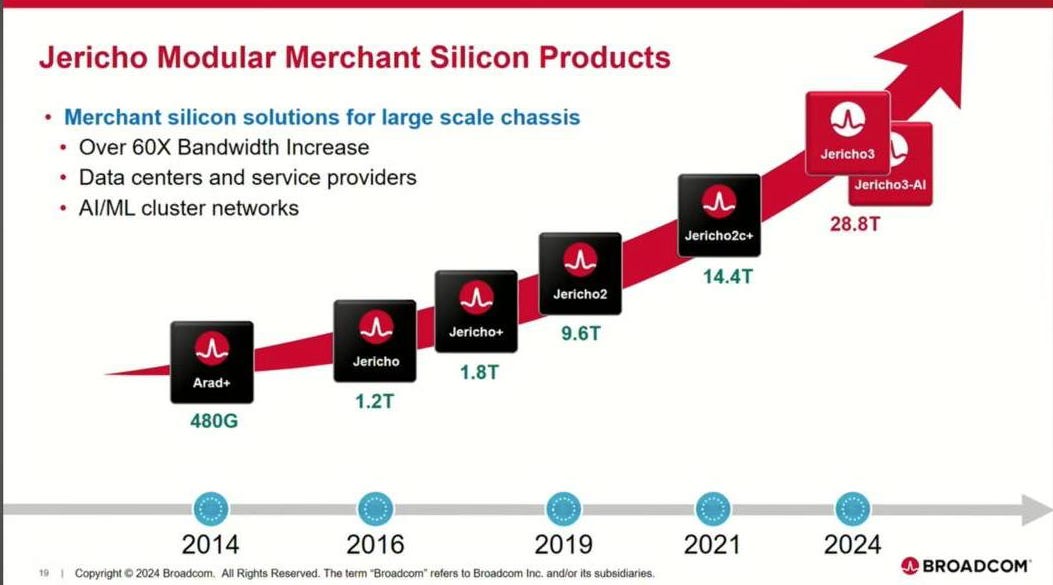
The key thing to note about the difference between StrataDNX™ (DNX) and StrataXGS® (XGS) is that DNX is for routing and XGS is for switching. This is because whilst XGS has some fast feed and speed combinations:
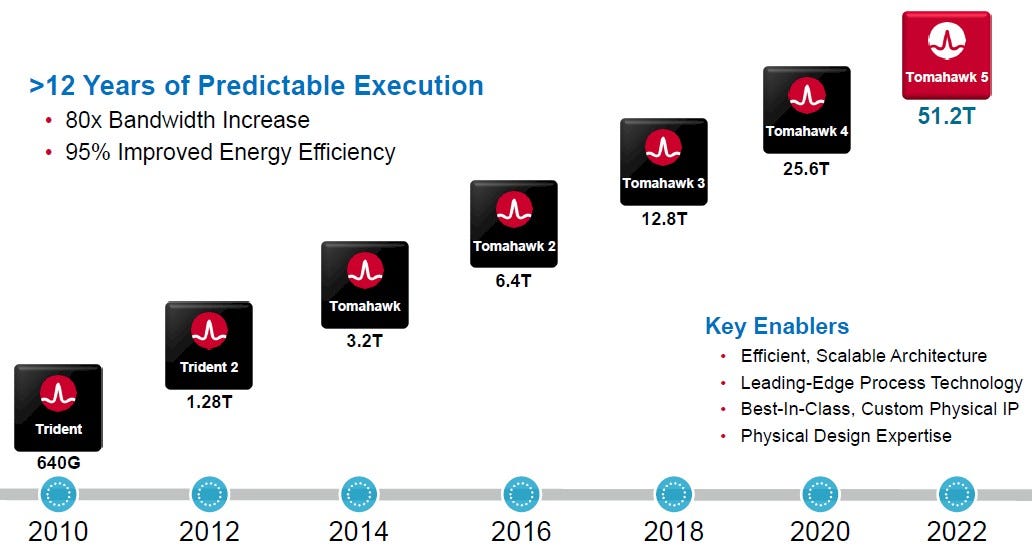
The Trident and Tomahawk chipsets that make up the XGS series are high capacity, high buffer, low memory compared with the Qumran (not shown) and Jerchio chipsets that make up the DNX series have lower top end capacity, however have good buffers and higher memory:
Summary
In my current opinion Merchant Silicon offers two distinct things over traditional vendors:
Feed and speed combinations in 1RU form factor that aren’t as readily available in traditional vendors, so for your edge cases or for problems that don’t meet your architectural templates, there’s probably a Merchant Silicon solution for you.
A faster path to side compute support, due to the nature of using Open Network Install Environment (ONIE).
Could Merchant Silicon Be For You?
If you have the time, patience, the hardware and NOS combination supports your use cases, and can find a supply chain that works for you and your organisation; then yes.
However don’t be lulled into the false sense of security that there’s a lower ‘price’, ‘TCO’ … etc., as the hidden costs is in your organisations R&D time to get a working solution, which you can ‘save’ with the traditional vendors (note you need a close working relationship with said vendors in order to truly leverage this).